

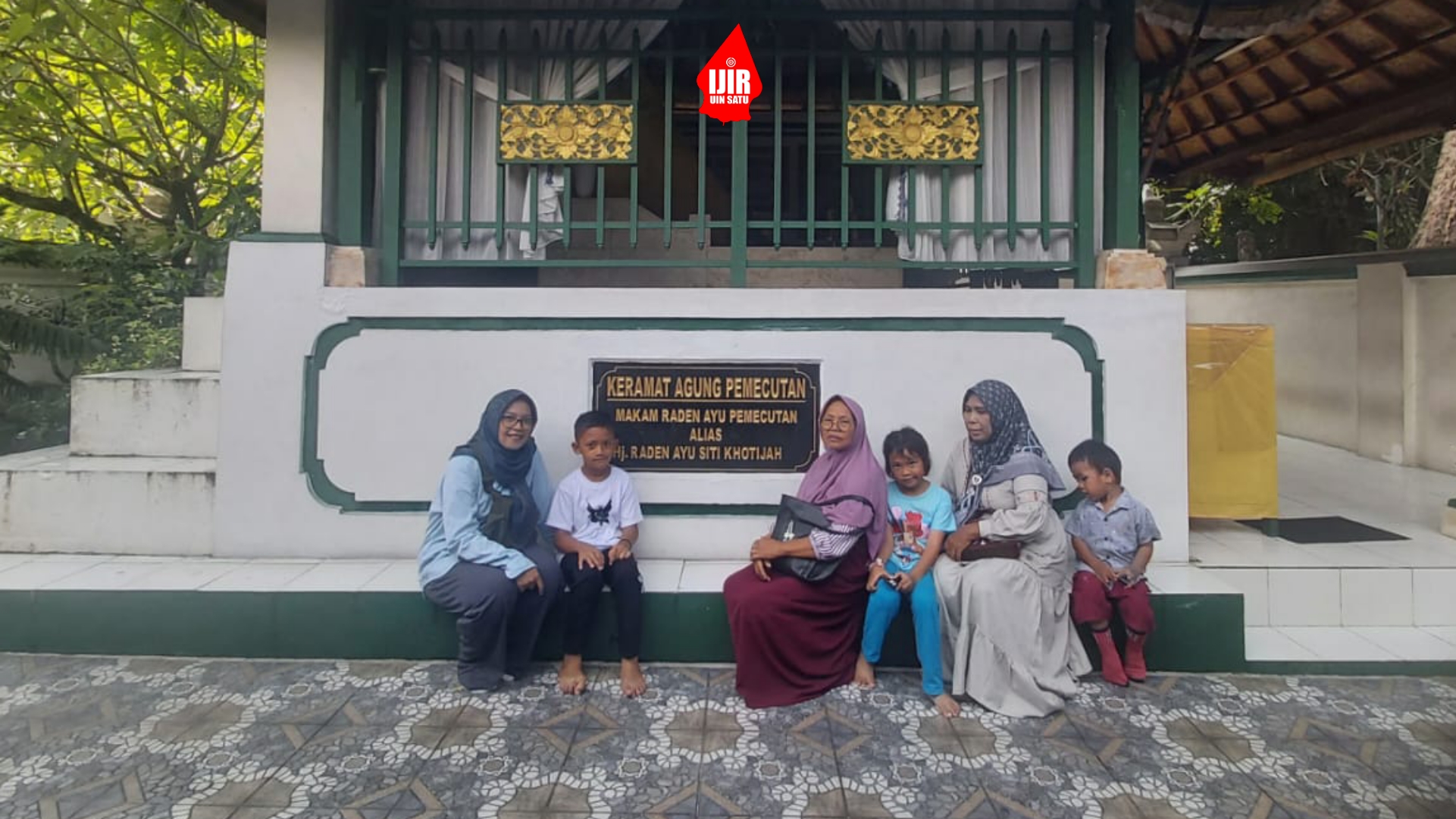
It was scorching hot when I rode my bike to the tomb of Raden Ayu Siti Khotijah or Raden Ayu Pemecutan in Pemecutan-Denpasar, Bali. I only need twenty minutes to reach this grave from my boarding house. This expedition is motivated after I read a fascinating book “Wali Pitu and Muslim Pilgrimage in Bali, Indonesia: Inventing a Sacred Tradition” by Syaifudin Zuhri. While living in Bali, as a Muslim, this book offered me a rich perspective – especially regarding the tradition of Muslim saint veneration in the midst of Hindu majority in Bali. This essay contains both my personal reflections on the book and my own experience.
Even though Siti Khotijah isn’t counted as Wali Pitu, this chance was still meant a lot to me. Notably, she is the only saint woman among Wali Pitu that has been mentioned by Zuhri. Beyond the seven official tombs of Wali Pitu, there are four alternative graves including Siti Khotijah’s grave. Her story gained popularity and she is considered as saint. According to local narrative, she is the daughter of king from the Pemecutan Kingdom who later converted to Islam.
I decided to visit earlier because Zuhri noted that the Wali Pitu pilgrimage tends to be quieter during the month of Ramadhan – about two couple months ago it was near of Ramadhan (1446 H) indeed. I saw there just one big bus in the parking area written “Ziarah Makam Wali 5 Bali”. Several women at the entrance informed that they from Tabanan. Then arrived a family with their car, they come from Singaraja. I followed them to entering the grave when an old Balinese women asked for sixty thousand rupiah to entering Khotijah’s grave, one of the tombs holds a special place within the Wali Pitu.
It is worth noting that scholar like George Quinn also has shared his visitation to this grave while reviewing Zuhri’s book (Quinn, 2024). I would like reemphasize Zuhri’s study that may have been overlooked by Quinn. In my opinion, Quinn missed an important part of this study, particularly Zuhri’s analysis using postcolonial theory on hybridity.
About The Book
This book is derived by Zuhri dissertation at Institut für Asien-und Afrikawissenschaften (IAAW) of Humboldt-Universität zu Berlin (2018). Published by Leiden University Press in 2022, this work presents not only a rare examination of saint worshiping tradition of Indonesian Muslim but also a sharp theoretical framework and methodology. Through the considered question “how was Wali Pitu invented and how is it marketed, experienced, and contested?” this book divided into two big parts: 1) Java and Bali in the Invention of the Wali Pitu, and 2) Question of Authority and Authenticity.
In the first chapter Zuhri demonstrate the general saint veneration in Indonesia (chapter 1). He argues that vernacularized sainthood emerged from the intersection of Islamic middle east tradition and influential local wisdom – such as veneration of kings, ancestors, and most notably spiritual teachers regarded as Wali. Thus, it is understandable that pilgrimage or Ziarah constitutes an important aspect of Muslim mobility in Indonesia. What is particularly intriguing is the study’s engagement with the concept of religious economy. It highlights the notion of “barakah” or blessing which becomes crucial thing among the pilgrims. Zuhri argued that the economic miracle of saints resonates clearly through the popular Javanese paraphrase “wong kang mati mung nguripi wong kang urip” [the dead only give life to the living].
In addition to outlining the fundamental elements of the saint veneration, this part mainly focuses on the invention of Wali Pitu and the memory-making (chapter 2). Toyyib Zaen Arifin (1925-2002), known as inventor of Wali Pitu and author of Manaqib Wali Pitu, recieved a divine massage (hatif) in 1992, guiding him to discover seven tombs of Muslim saints. Initially, he was recognized as kiai kampung in Wedoro village, East Java, before gradually gaining authority and become a respected figure among his santri in Bali. Under Toyyib Arifin’s leadership, the community expanded and formally named as Al-Jamali in 1995. This organization took the central role in sustaining the veneration of Wali Pitu. Member were obligated to seek for the saints’ graves based on Arifin guidance, as well as propagated the stories, offering pilgrimage package and accommodation, organizing the haul commemorations, and even sell Wali Pitu images and souvenirs.
The seven-figure recognized as Wali Pitu are: 1) Habib Umar Bin Maulana Yusuf Al-Maghribi, 2) Habib Ali bin Abu Bakar al-Khamid, 3) Habib Ali bin Zainal Abidin al-Idrus, 4) Habib Ali bin Umar Bafaqih, 5) Shaykh Yusuf al-Baghdi, 6) The Kwan Lie or Shaykh Abdul Qadir Muhammad, and 7) Mas Sepuh or Raden Amangkuningrat.
Under the Arifin authority, Al Jamali successfully developed a Wisata Religi (religious tourism) which Zuhri described as the essence a hybrid religious travel in Bali. Furthermore, Zuhri boldly analyses how this narration is preserved through “Memory-Making”. In this concept, Zuhri illustrates the worship ecosystem of Wali Pitu is maintained through the following aspects: Hatif and pentashih (validation), canonisation, mediatisation in the Manaqib Wali Pitu book, materialisation via the saints’ graves, visualisation through saints’ images, ritualisation by held Haul, and lastly, saint-branding.
In the case of Bali, Wisata Religi as mentioned above presents a mixture of tourism and pilgrimage (chapter 3) so that Zuhri argued this form of hybrid religious travel. As a religious entrepreneur, there are production and transaction of intangible commodities such as blessing, healing, salvation, and protection. In other side, Zuhri observes the tourism itself. For instance, Zuhri notes that his four interlocutors identified themselves as pilgrims when visiting a sacred grave, but as tourist when spending time at beaches. For this reason, Zuhri concluded that the Wali Pitu bring different – sometime contradictory – variables together.
In the second part of this book, the discussion led to authority and authenticity issues. Zuhri investigates several significant locations such as Loloan village, where the Al Qabla Wujud or Ali Bafaqih’s grave, the most visited tomb out of seven saints in Bali, is situated (chapter 4). The second location is a sacred site with the least visited grave of Wali Pitu, located in the mixed Hindu-Muslim village of Candikuning (chapter 5). The last part of this book, in my view, presents one of the most noteworthy findings of Zuhri’s work: the concept of “sharing the sacred” it refers to Pura Keramat Ratu Mas Sakti in the Hindu village of Seseh in southern Bali, where there is a practice of sharing a sacred place by Muslim and Hindu pilgrims (chapter 6).
In this subsection, Zuhri employs Homi Bhabha’s theory of hybridity and transgressing boundaries to explain the unique characteristics of Pura Keramat and its pilgrims. In this location, Mas Sepuh was buried and was officially declared as a Hindu temple in 2013. However, according to Zuhri, this temple has been accommodating of Javanese Muslim and Balinese Hindu culture in a single sacred place.
Methodology and Self-Correction
Zuhri claimed that his study adopts transdisciplinary approach, combining history, area studies, and ethnography. I believe this approach is particularly compelling for many scholars in the social sciences. For example, his use of mobile ethnography and multi-sited ethnography offers a flexible and comprehensive method especially when one studying pilgrimage tradition. Moreover, this approach positions informants as interlocutor rather than merely a source of information.
As a young scholar, I quite often hesitate to state of my academical mistake. This study has taught me that meaningful criticism begins with oneself. Zuhri vividly mentioned that his aim to self-correction of his previous article entitled “Inventing Balinese Muslim Sainthood”. In that earlier work, he had claimed that the Wali Pitu represented saint worshipping tradition rooted in Balinese Muslim – a claim he now considers is misleading. Through this book he dismantled that the Wali Pitu has Javanese rather than Balinese roots. The modest thing of this work is when I found the Zuhri’s confession about his background and objective truth; he wrote “I am also fully aware that my Western educational background could also be reductive and potentially ignore epistemological complexities at work. Thus, my ‘ethnography story’ through this book only represent ‘partial truths’ “. This statement reflects how Zuhri is carefully aware of and avoid to claiming the absolute truth which can be misleading within the academic field.
In my opinion, this book could serve as a valuable entry point for studying the veneration of Wali Pitu in contemporary Indonesia. Furthermore, I think the discussion of sainthood in Indonesia should pay closer attention to gender relation perspective. As far as I search the discussion on sainthood – particularly in the widely known narratives of the Wali Songo in Indonesia – there is no attention to look the gender aspect whereas the fact is that dominance of sainthood is male. Similarly, the discussion of Wali Pitu also tends to sideline gender-related concerns. My own visit to Siti Khotija’s grave made me more aware of how gender dynamics are significant in saint worship tradition. Although there is an article by Mark Woodward – “The Apotheosis of Siti Khotijah: Islam and Muslim in a Balinese Galactic Polity” (2018) – that discuss about Siti Khotijah it does not approach the topic through gendered lens. This highlights the need for future research to critically engage with gender perspectives in the study of sainthood in Indonesia.
All in all, Zuhri’s study of the saint veneration tradition stands as an important contribution that brings attention to Indonesian Muslim living in minority setting – that often overshadowed by dominant narratives shaped by the Muslim majority. His rich, combined methodological approach and the clarity of his analysis make this work worthy to exemplify by wider scholars in Indonesia.